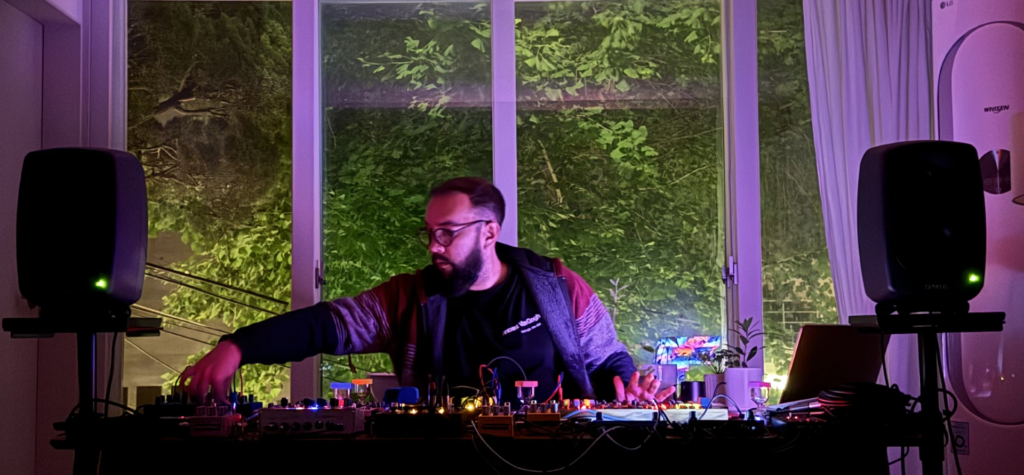
Jorge Durán Rodríguez is a composer, Latin percussionist, and vibraphonist who defines himself as a Bard Metamodernist—an artist bridging storytelling, tradition, and technological innovation to create music that transcends borders and time.
Born and raised in Venezuela, Jorge began his musical journey at the age of eight, deeply rooted in the vibrant rhythmic traditions of his homeland. Over more than three decades, he has developed a distinctive artistic voice that interweaves Afro-Caribbean and Afro-Cuban rhythms, jazz language, and Latin American heritage with contemporary electronic music and experimental production.
At the core of his artistic identity is an expanded approach to the vibraphone. Through electronic processing, live modulation, and custom signal chains, Jorge transforms the instrument into a platform for immersive sonic architecture—merging acoustic resonance with granular textures, field recordings, and rhythmic experimentation. His work continuously explores the balance between ancestral memory and future-oriented sound design.
Jorge’s artistic path has unfolded across continents, with formative experiences in Brazil, the United States, Germany, Spain, Italy, and his native Venezuela. While living in Madrid, he composed music for film and led a mambo revival project that reimagined the golden era of 1940s Afro-Cuban music through a contemporary lens. Later, in Germany, his focus shifted toward modern music production, resulting in seven albums that combine cultural narrative, rhythmic abstraction, and electroacoustic exploration.
His performances extend beyond sound into the audiovisual realm. Integrating video synthesizers and custom visual systems, Jorge creates immersive, multisensory concerts where rhythm, image, and narrative coexist. His solo performances in South Korea marked an important expansion of his international presence and demonstrated his ability to connect deeply with diverse audiences.
In 2025, Jorge returned to Asia and performed in Tokyo, where he also recorded an album in collaboration with a local composer—an encounter rooted in rhythmic dialogue and intercultural listening rather than stylistic fusion.
Later that year, he released Watercolor—a concept-driven work that reflects his metamodern philosophy. Conceived as a sonic study of color through the voice as emotional architecture, each piece functions as a tonal pigment: layered, translucent, and in constant transformation. The album unfolds as a gradual expansion of space and perception—moving from intimate, granular piano textures and spatialized electric guitar to rhythmically charged passages shaped by hard panning, deep delays, and sculpted electronic environments.
Rather than presenting rhythm as fixed structure, Watercolor treats it as fluid matter—time dissolving and reassembling through resonance, breath, and repetition. Jorge composed, performed, recorded, and produced the entire project independently, extending his authorship into the visual dimension through a series of self-directed videos. In doing so, he positions the album not merely as a collection of pieces, but as a unified audiovisual body of work—an exploration of vulnerability, abstraction, and rhythmic memory rendered through color and sound.
Jorge Durán Rodríguez’s music invites listeners into a living dialogue between past and future, ritual and technology, rhythm and transformation—an evolving narrative in which heritage is not preserved as nostalgia but activated as a force for contemporary creation.